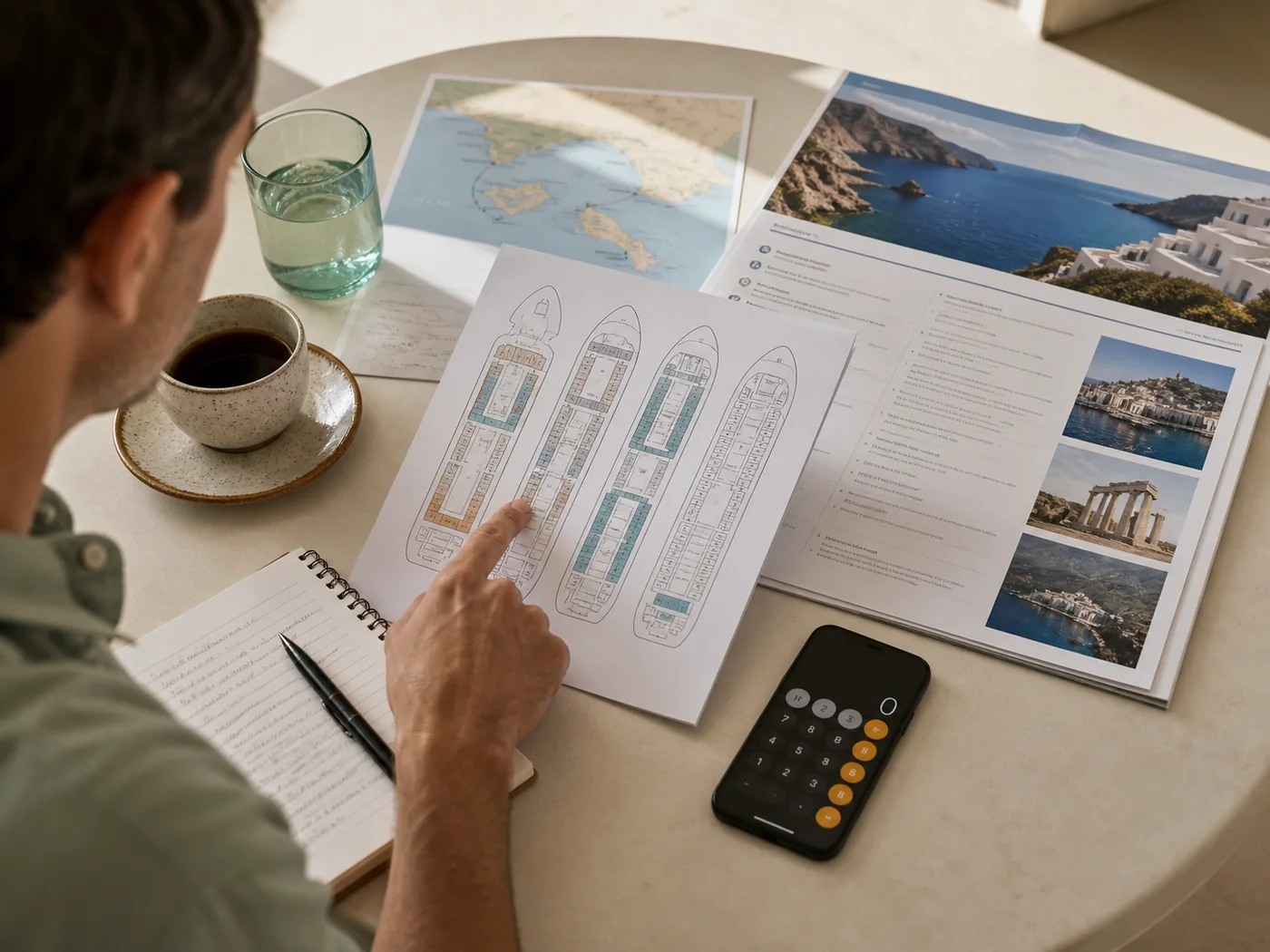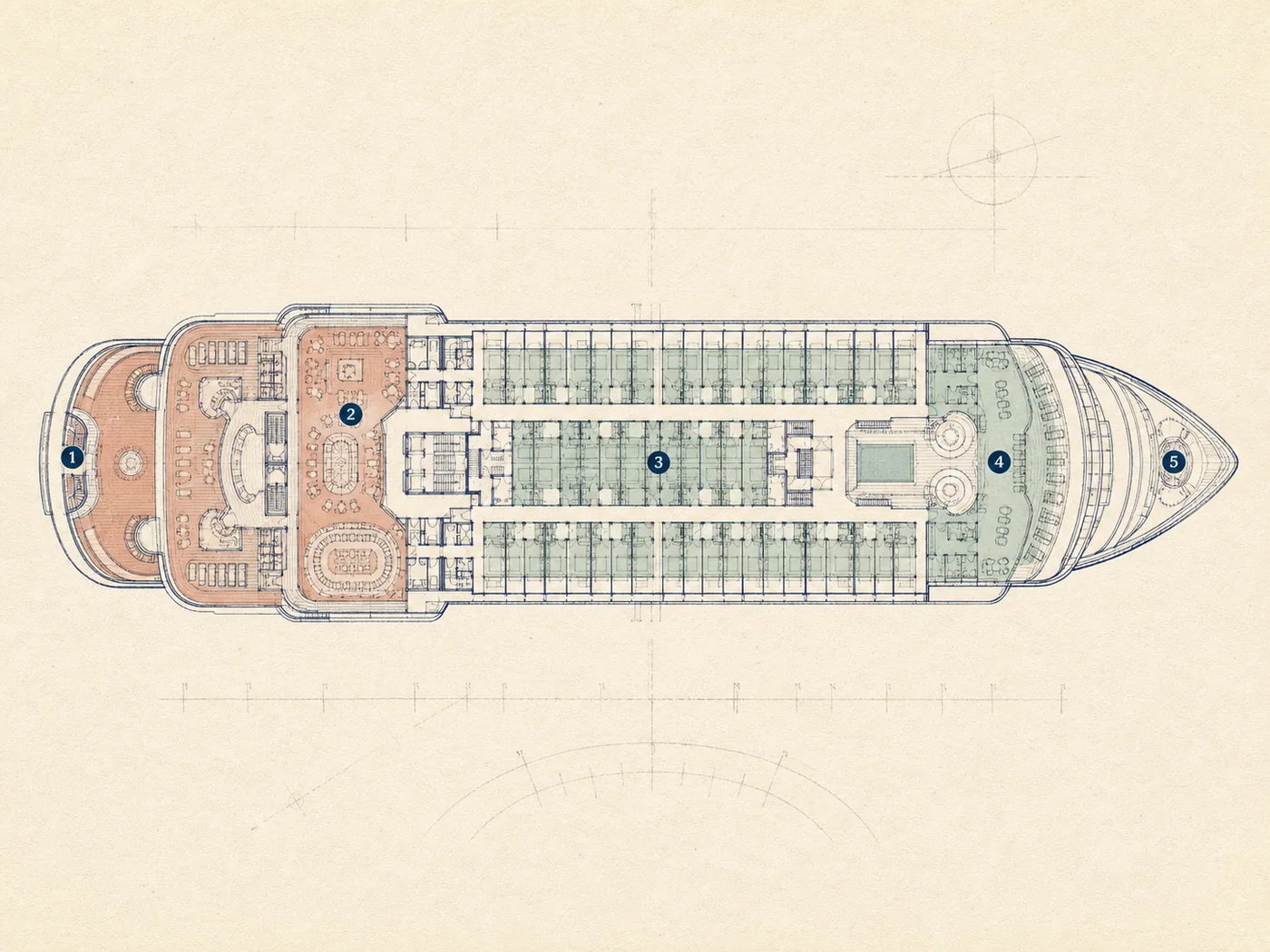
Cabin photos show finishes and furniture. A deck plan shows the clues that shape sleep, privacy, movement, and convenience. Read it vertically as well as horizontally.
Quick take
What matters most
- Inspect the decks above and below, not only the cabin’s own deck.
- Look for blank spaces, service doors, stairwells, and connecting-room symbols.
- Choose location around your priorities: quiet, low motion, access, view, or price.
- Use the current plan for the exact ship; sister ships and refits can differ.
Start here: deck numbers are labels, not quality rankings
There is no single answer to how many decks a cruise ship has: check the exact vessel rather than borrowing another ship’s numbers. A higher deck number does not, by itself, mean a better cabin. First locate your cabin, then read the spaces beside it and on the levels above and below.
Use the legend supplied with that plan, not a colour or symbol remembered from another ship. The official MSC World Europa PDF explains its accommodation symbols and categories; Royal Caribbean’s Odyssey of the Seas page has a separate deck legend and sailing-date selector. These are examples of where to start, not recommendations for a particular cabin.
Choose the version covering your sailing where one is offered, check which way is forward, and match lift or stair cores before comparing levels. Deck diagrams may not use the same scale. If you cannot confidently align the same position, ask the cruise line or seller before paying.
1. Check what is directly above and below
Dining rooms are not the only spaces that matter. Pool decks can bring early furniture movement, theaters can run late, and fitness areas may create impact noise. A cabin deck above and below is the simplest quiet-location starting point.
Align the plans carefully. Staircases and elevator cores help you match the same position across decks when the diagrams use different scales.
2. Investigate blank space and service areas
An unlabelled block can be harmless structure, but it can also conceal crew access, storage, machinery, or a service pantry. Look for doors, corridors that stop abruptly, and nearby public venues. If the location matters, ask the cruise line or seller what occupies the space.
3. Map hallway traffic
Elevators are convenient; elevator lobbies can be social and busy. Cabins beside stairwells, laundry rooms, kids’ areas, or doors to open decks may hear more passing conversations and door movement.
A few cabins away from the main route can preserve convenience without placing your door at the center of traffic.
4. Think about motion before the view
Ship movement varies with weather, speed, hull design, and itinerary. As a general starting point, lower and more central cabins usually experience less pronounced movement than high cabins near the bow or stern.
Cabin location is not a medical guarantee. The CDC advises travelers who expect seasickness to discuss suitable prevention or medication with a healthcare professional before travel.
5. Separate movement from vibration and operational noise
Aft cabins can offer distinctive views, but propulsion vibration may be more noticeable on some ships. Forward cabins can be affected by bow movement, wind, anchors, or thrusters depending on the vessel and arrival schedule.
Reviews are most useful when they identify the exact ship, cabin number, route, and date. Avoid turning one person’s experience on one sailing into a rule for every ship.
6. Check connecting doors, obstructions, and privacy
Connecting cabins are useful for families but may transmit more sound through the internal door. Obstructed-view categories can be good value when daylight matters more than a clear panorama, but the obstruction may range from minor equipment to a lifeboat dominating the window.
Promenade-facing and inward-facing rooms create a different privacy trade-off. Look for sightlines from public areas as well as the view from inside the cabin.
7. Test the location against your daily route
Imagine breakfast, the pool, dinner, the theater, gangway days, and bedtime. A location that saves repeated long walks can matter more than a theoretically quieter position, especially for travelers with reduced mobility or families carrying gear.
Finally, verify the current deck plan for the exact vessel and sailing. Refits can change venues, cabin categories, and access routes.
Putting the seven checks together: Cabin A or Cabin B?
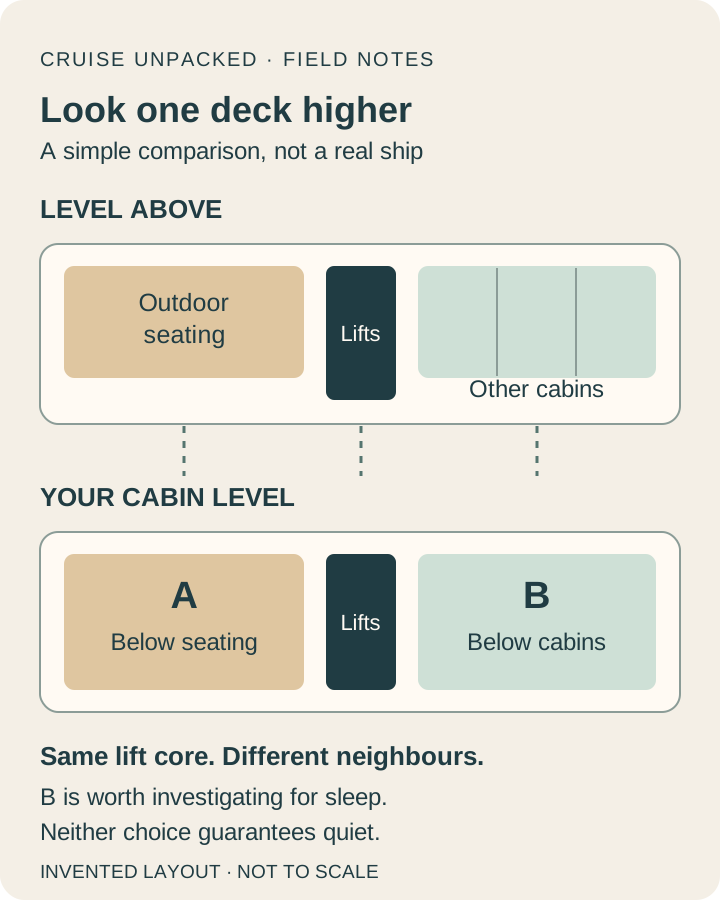
In the invented drawing above, A is directly below outdoor seating; B has cabins above it. If sleep is your first priority, B is the more promising option to investigate—not a guaranteed quieter cabin. Furniture movement is a possible concern for A, but a deck plan cannot tell you how often it happens or how much sound reaches the room.
Before choosing B, inspect the deck below, connecting-door symbols, service spaces and its corridor position. Neither a better-looking spot nor a higher category replaces those checks. For either option, compare the actual view, bed arrangement, walking route and total fare for the same sailing.
A useful question for the seller is: “What is directly above, below and beside this exact cabin, and are there service doors or connecting rooms nearby?” If a blank area or unclear symbol remains unexplained, save the plan and get that point clarified rather than guessing.
Save before booking
Deck-plan screenshot checklist
Deck above and deck below saved
Public rooms and service areas identified
Elevators, stairs, and open-deck doors checked
Motion and vibration trade-off considered
Connecting door and view symbols understood
Walking route tested against our daily priorities
Exact ship and current plan confirmed
Official source notes
These sources support the operator rules and practical travel points in this guide. Our recommendations are editorial judgments, not promises by a provider. Accessed October 4, 2026.