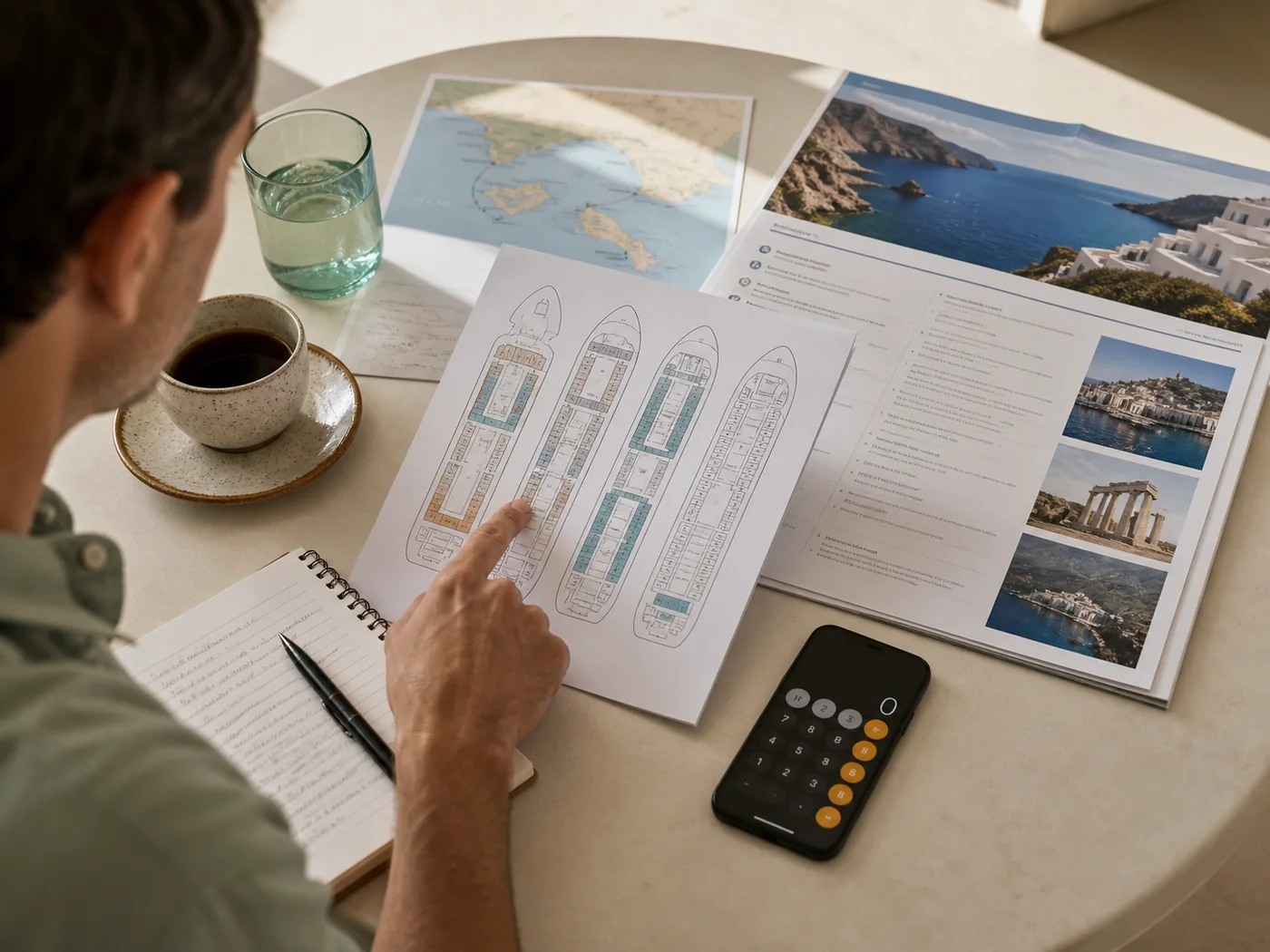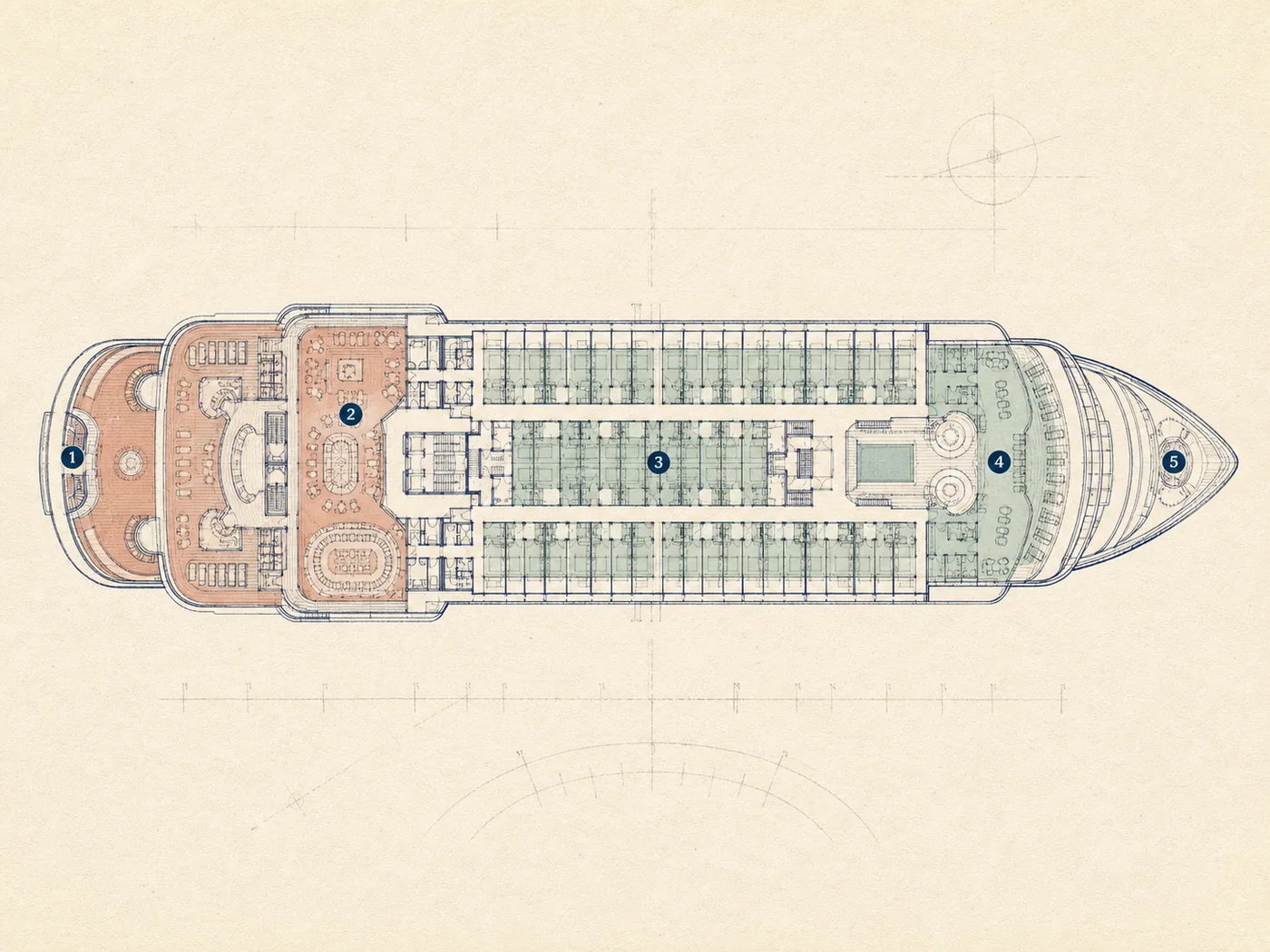
The headline fare may not be the amount that leaves your account. Depending on the cruise line, booking market and fare, crew gratuities may be included, prepaid or added each day onboard. Drinks, specialty dining and spa services can then carry separate automatic percentages. The reliable method is to read the written quote and calculate your own trip total.
Quick take
What matters most
- Look for gratuities, service charge or crew appreciation on the actual quote—not only the search result.
- Calculate the daily amount for every chargeable guest and every billed night.
- Keep daily crew charges separate from percentages added to drinks, dining, room service or spa purchases.
- Save the confirmation and review your onboard account before the final morning, while questions can still be raised.
1. Translate the label before comparing prices
Cruise lines use several labels for a similar budget line: gratuities, service gratuity, onboard service charge, hotel service charge or crew appreciation. The operator’s own terms decide what the charge covers and whether it is included, optional, adjustable or automatically posted. Do not assume that the word ‘gratuity’ works exactly like a restaurant tip in your home country.
Start with the booking confirmation for your exact guests, fare and sailing. Find the daily crew charge, then look separately for service charges on optional purchases. If the seller says an item is included, ask where that inclusion appears in writing. A verbal assurance or a generic fare badge is difficult to verify later.
2. Check whether this fare already includes it
Some cruise products include the main crew charge. P&O Cruises currently says good service is included in the price of its holidays and tipping is not expected or needed. Other operators add a daily amount unless it is prepaid or included by a particular fare or promotion. The policy can also differ by the country in which the booking is made.
Compare two quotes line by line. One may show a higher cruise price with gratuities included; another may show a lower fare and move the charge to a prepayment or onboard account. Mark each line as included, payable before sailing, automatically added onboard or genuinely optional. Only then compare totals.

3. Do the per-person, per-night calculation
Use one simple formula: daily amount × chargeable guests × billed nights. Do not use the cabin price as the multiplier, and do not assume a child is exempt without checking the operator’s age rule. If a suite has a different daily amount, calculate it with the suite rate shown on the quote.
Current operator examples show why a universal number is unsafe. As checked on September 19, 2026, Royal Caribbean lists $18.50 per guest per day for non-suite cabins and $21 for suites; Carnival lists $17 and $19; Norwegian lists $20 for Club Balcony Suite and below and $25 for The Haven and Suites. MSC publishes different amounts by region, accommodation, guest age and sometimes booking date.
A transparent example using Royal Caribbean’s current non-suite amount: two chargeable guests × seven days × $18.50 = $259. That is an illustration of the calculation, not a quote for a future sailing. Recheck the official page and your confirmation because rates and inclusions can change.

4. Check children, suites, region and booking date
Age rules are not consistent. Carnival’s current guidance exempts children under two; Norwegian applies its service charge to guests aged three or older; MSC says its hotel service charge does not apply below age two and publishes age bands for several regions. A family should therefore calculate from the policy attached to its cruise, not copy another traveler’s total.
Accommodation and geography can matter too. Suite rates are higher in the Royal Caribbean, Carnival, Norwegian and MSC examples above. MSC’s published table also changes by destination and distinguishes some bookings made before or after named 2026 dates. Record the currency as well as the number: a dollar, euro or pound amount should not be silently treated as interchangeable.
5. Separate daily charges from purchase percentages
The daily crew charge is not the end of the calculation. Royal Caribbean currently adds 18% to beverages, beverage packages, specialty dining, room service and minibar purchases, and 20% to spa and salon purchases. Carnival lists 20% on beverages and specialty dining. Norwegian lists 20% on beverage purchases, specialty dining and spa or salon services.
Read what a package already includes before adding another percentage yourself. A drinks or dining package may include its own service charge in the checkout total, while an à-la-carte purchase may add it onboard. Cash given voluntarily for exceptional service is a separate personal decision; do not automatically add it as though it were another mandatory line.

6. Decide whether prepaying helps your budget
Prepaying can make the remaining onboard balance easier to understand and may lock in the amount offered at the time of payment. Royal Caribbean, Carnival, Norwegian and MSC all describe a prepayment route in their current guidance. The deadline, refund treatment and effect of later booking changes are operator-specific, so save the terms shown when you pay.
Paying onboard keeps the charge visible on the ship account but exposes the final home-currency cost to the card’s exchange rate and any applicable card fees. Neither route automatically includes every beverage, dining or spa percentage. Choose based on the written total and your payment method, not on a blanket claim that prepaying is always cheaper.
7. Understand the adjustment policy before relying on it
Several operators tell guests to raise service problems onboard. Royal Caribbean and Carnival say their posted gratuities can be adjusted onboard before disembarkation under the conditions on their current pages. MSC says its calculated daily amounts cannot be modified, while also describing removal through the Guest Relations Manager when service is unsatisfactory. Those word choices are not interchangeable.
Treat adjustment as a service-resolution process, not as the default way to make a cheap fare cheaper. If something is wrong, report it while the team has an opportunity to respond and ask what change is actually permitted for your booking. Do not wait until after the voyage: operator pages commonly set an onboard deadline.
8. Reconcile the account before the final morning
During the cruise, check that prepaid or included items are not being charged a second time and that each percentage-bearing purchase matches what you authorized. Keep receipts until the account is settled. If you see an unfamiliar line, ask Guest Services to explain the category rather than assuming every service-related amount is the same gratuity.
For future comparisons, save three numbers: the advertised cruise fare, the complete pre-sailing total and the final onboard spend. This turns a vague memory of whether a cruise felt expensive into a useful record for choosing the next trip.
Save before booking
Seven gratuity checks before you sail
Exact operator, booking market, fare and sailing policy saved
Included, prepaid and onboard items separated
Daily amount multiplied by every chargeable guest and billed night
Child, suite, region, currency and booking-date rules checked
Drink, dining, room-service and spa percentages listed separately
Prepayment deadline, refund terms and adjustment process understood
Booking confirmation and onboard account reviewed for duplicate charges
Official source notes
These sources support the operator rules and practical travel points in this guide. Our recommendations are editorial judgments, not promises by a provider. Accessed September 19, 2026.