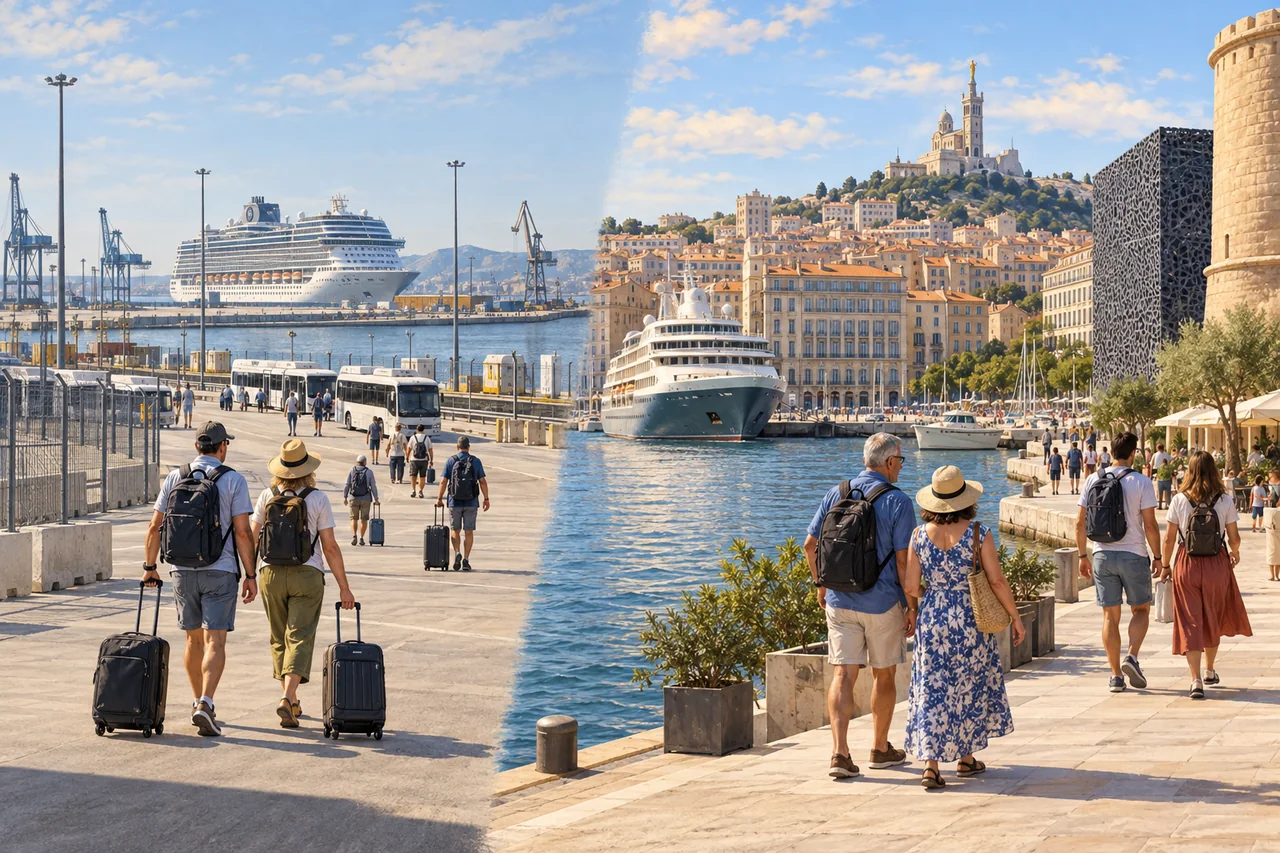
The words ‘Marseille cruise port’ can describe two very different starts. Many large ships use the Marseille Provence Cruise Terminal area at Gate 4, roughly six kilometres from the centre. The J4 terminal sits beside the city waterfront. A plan that works from one should not be copied to the other. Confirm the berth first, then build the day from the transport you can actually use.
Quick take
What matters most
- Look for MPCT, Môle Léon Gourret, Gate 4 or J4 in the ship’s instructions; ‘Marseille’ alone is not enough.
- Do not plan to walk from the main Gate 4 cruise-terminal area to the centre. Compare the port shuttle, RTM 35T, a ship shuttle and a taxi.
- Treat Joliette as the transport handoff, not the Old Port itself. You still need a short city leg or a waterfront walk.
- Save the correct return stop and leave-now time before sightseeing. A free shuttle timetable is not an all-aboard guarantee.
1. Confirm whether you are at Gate 4 or J4
The Port of Marseille Fos directs access to MPCT and terminals A–E through Gate 4. Its separate J4 terminal is beside the Vieux-Port side of the city, near the Major cathedral, Mucem and Le Panier. Marseille Tourism says a cruise call will probably use Môle Léon Gourret or J4, but that is background information—not a berth assignment for your sailing.
Read the cruise line’s app, daily programme or port notice before arranging a pickup. Record the terminal name, the place where independent passengers leave the secure area and the point to which you must return. If the information only says ‘Marseille’, ask for the terminal. A driver waiting at J4 cannot solve a meeting arranged at Gate 4.
The two settings also change what counts as a realistic day. From J4, the waterfront can begin on foot. From the main cruise terminals, the transfer to Joliette is the first part of the outing and must be counted in both directions.
2. From Gate 4, solve the trip to Joliette first
Marseille Tourism currently describes a free port shuttle on ship-call days. For the outward trip, its directions tell passengers to follow the green line from the ship and walk about five to twelve minutes to the marked stop near the Gate 4 exit. For the return, the published Joliette pickup is at 9 Quai du Lazaret, between Les Terrasses du Port and the maritime station. Save the current directions rather than relying on where a bus happened to stop on an earlier cruise.
Another official tourism page currently gives a 9 a.m.–5 p.m. operating window at roughly 30-minute intervals. That is useful planning information, not a promise for every minute of your call. Service can be affected by the day’s operation, queues and your ship’s schedule. Recheck close to arrival and keep another workable option.
RTM identifies the 35T as the direct public-bus link between the cruise terminal and Place de la Joliette. Its schedule changes with the number of cruise ships expected, using different service patterns on call days; RTM excludes May 1 from this service information. Check the current 35T timetable for both directions and validate the fare required for the journey. A regular route, cruise-line shuttle or taxi may also be available, but the meeting point, price and return need confirming for your sailing.

3. Joliette is the handoff, not the final attraction
The port shuttle and 35T bring the main cruise-terminal journey into the Joliette area. Marseille Tourism currently estimates the walk from Place de la Joliette to the Vieux-Port at about 25 minutes and lists local bus alternatives. Another official city-arrival page gives roughly 20 minutes from the maritime-station area. Read those as orientation: crossings, heat, crowds and your exact stop change the real time.
A useful low-complexity plan begins in Joliette instead of immediately crossing the city. The Major cathedral, the J4 cultural waterfront, Fort Saint-Jean, Mucem and the edge of Le Panier form a connected area. The Old Port can then be the continuation rather than the first rushed transfer.
If your ship is already at J4, reverse the logic: locate the terminal entrance first, then walk into the same waterfront area. Do not travel out to the Gate 4 shuttle stop simply because a generic port guide mentions it.
4. Our first-visit plan: waterfront, Le Panier and the Old Port
For a first call, our lower-risk route is one connected city story: begin around the J4 waterfront, choose whether Mucem exhibitions matter to you, cross through the Fort Saint-Jean setting, explore a manageable part of Le Panier and continue toward the Old Port. Marseille Tourism’s own one-day and half-day suggestions connect these areas, but they are inspiration rather than a fixed cruise excursion.
Mucem’s current rules say the museum closes on Tuesdays, with opening hours changing by season and last admission before closing. Check the official schedule for your date before buying a timed product. Do not assume the route through Fort Saint-Jean and its footbridges is available when the museum site is closed; use the surrounding public streets if access is unavailable. Walking around the waterfront does not automatically include entry to every exhibition, and an attraction ticket does not include transport from your ship.
Keep the route elastic. If the transfer into town takes longer than expected, shorten Le Panier or make the Old Port your turning point. If you arrive at J4 with a long call, you can spend more time inside a museum or over lunch without inventing a second distant itinerary.
5. Treat hills and surfaces as part of the itinerary
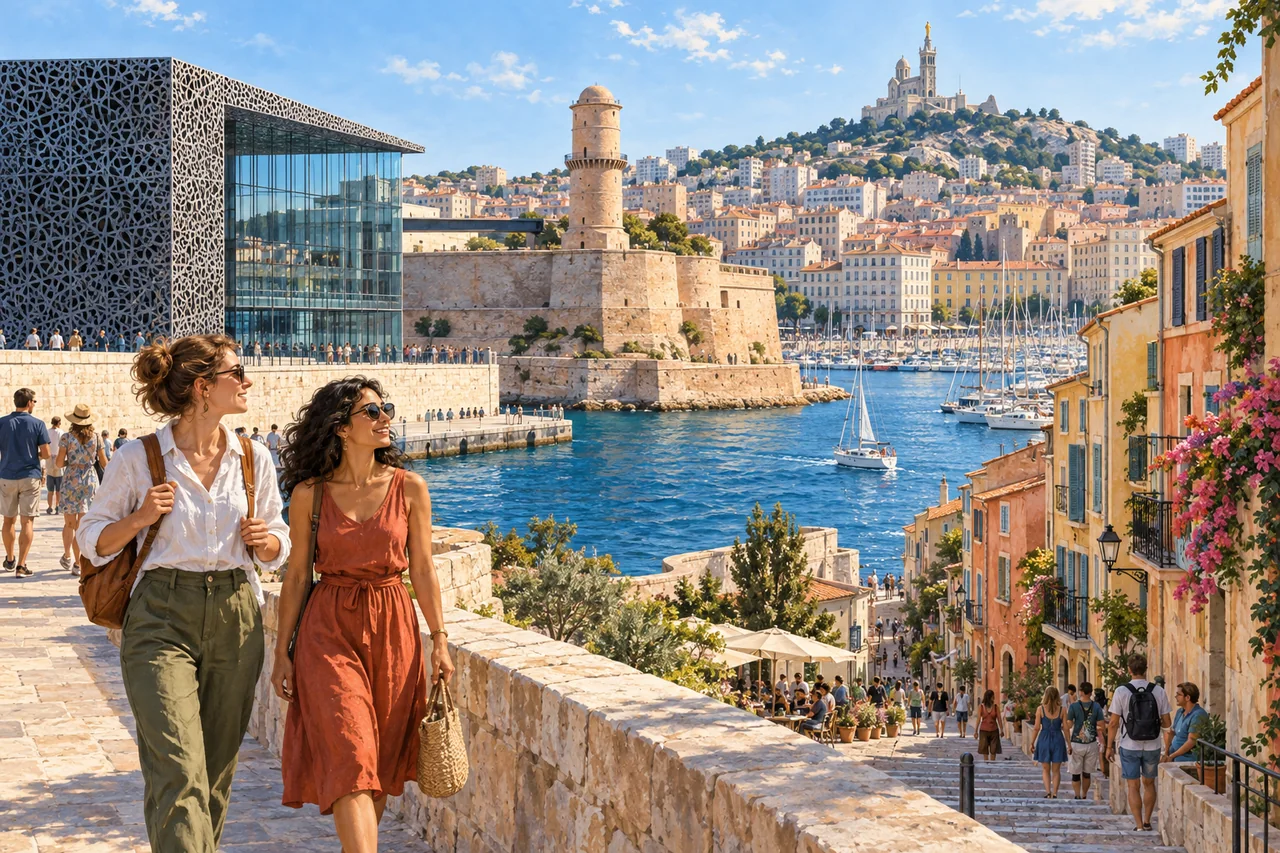
Le Panier is rewarding precisely because its lanes climb, turn and narrow. Marseille Tourism’s accessibility guidance warns that parts of the old quarter are steep, with narrow pavements and stairs. A route described as ‘walkable’ can still be a poor match for a wheelchair user, a stroller, heat or someone who tires easily.
Choose the accessible version before the group is exhausted. That may mean staying on the flatter waterfront, using city transport for one elevation change, arranging an appropriate vehicle or visiting fewer places. Ask the cruise line and any tour provider about the complete chain from gangway to vehicle to attraction; a general accessibility icon does not answer every connection.
Notre-Dame de la Garde is visible from much of the waterfront, but reaching the hill is a separate transport and time decision. Add it only when it is the priority and the return plan still works. Seeing the basilica from the city is not a failed visit if climbing or another transfer would make the day less enjoyable.
6. Build the return from the correct stop
For Gate 4, save both the Joliette departure point and the path from the port-side shuttle stop back to your terminal. The tourism office currently says returning passengers should show their cruise ticket when entering the Joliette gate. Keep the ticket and ship contact details available offline rather than buried in email.
For RTM 35T, check the direction and call-day schedule. For a taxi or private transfer, agree the meeting point in words and on a pin; ‘cruise port’ is still too vague. For J4, identify the pedestrian entrance you used and do not assume every secured gate will admit passengers.
Set a leave-now time by working backward from the ship’s all-aboard instruction. Include the city-to-Joliette leg, waiting, the port transfer and the final walk or security process. There is no universal buffer that guarantees a return. If the outward journey runs late, remove part of the city plan instead of spending the return allowance.

7. Embarkation day is a different transport problem
If your cruise starts or ends in Marseille, luggage and check-in replace the simple port-call calculation. Marseille Tourism says there is no single direct public link from the airport or Saint-Charles station to the main cruise port. RTM describes Metro line M2 from Saint-Charles to Joliette and the 35T onward on cruise-call service, but that combination still involves luggage handling, waiting and the terminal-side connection. The tourism office warns that the final distance from the bus stop to the boarding platform can be 600 metres to 2.5 kilometres: check your berth rather than assuming the bus stops at the gangway.
Compare a public-transport sequence, cruise-line transfer and prearranged vehicle using the exact terminal, passenger count, baggage, child-seat needs and arrival margin. Do not use a transit-passenger shuttle assumption as an embarkation guarantee. If a same-day delay would threaten check-in, the stronger solution may be arriving in Marseille earlier rather than searching for a faster final transfer.
Cruise Unpacked provides independent planning guidance and does not operate the port, shuttle, bus, taxi, attraction or cruise. Confirm current service, prices, access and terms with the responsible provider before relying on them.
Save before booking
Your Marseille port day, in seven checks
Gate 4/MPCT or J4 confirmed from the ship’s instructions
Port exit and exact return entrance saved
Primary and backup transport checked in both directions
Joliette-to-city leg included in the timing
One compact sightseeing priority chosen
Hills, surfaces and access needs considered
Leave-now alarm, cruise ticket and ship contact stored offline
Official source notes
These sources support the operator rules and practical travel points in this guide. Our recommendations are editorial judgments, not promises by a provider. Accessed September 20, 2026.
- Port of Marseille Fos — cruise passengers, Gate 4 and J4
- Marseille Tourism — access to Marseille Cruise Port
- Marseille Tourism — city arrival and port-shuttle operating guidance
- RTM — cruise passengers and the 35T service
- Marseille Tourism — visiting Marseille in one day
- Marseille Tourism — accessible sites and Le Panier
- Mucem — current visitor questions and opening information